BBLabs NewsBBLabs News
NewsAll articlesTopics
ES
BBLabs NewsBBLabs News

BBLabs News

Una historia al día. Cero ruido.

Newsletter técnica de ciberseguridad. Una historia al día sobre CVEs críticos, brechas, bug bounty e IA. Filtrado por IA, escrito para humanos.

Producto

  • Hemeroteca
  • Ediciones
  • Temas
  • Glosario
  • RSS
  • Atom
  • JSON Feed

Editorial

  • Acerca de
  • Suscribirse
  • Cuenta
  • English

Legal

  • Privacidad
  • Términos
  • Contacto: team@bblabs.es

Conectar

  • YouTube · @0xGorka
  • Instagram · @bblabs.es
  • Discord BBLabs
  • Discord Bug Bounty ES
29 artículos·9 ediciones·Desde 2026·Hecho en España
© 2026 BBLabs News·Por Gorka El Bochi
BBLabs NewsBBLabs News
NewsAll articlesTopics
ES
ChatGPhish: how ChatGPT web summaries become phishing lures
Back to homeIA

ChatGPhish: how ChatGPT web summaries become phishing lures

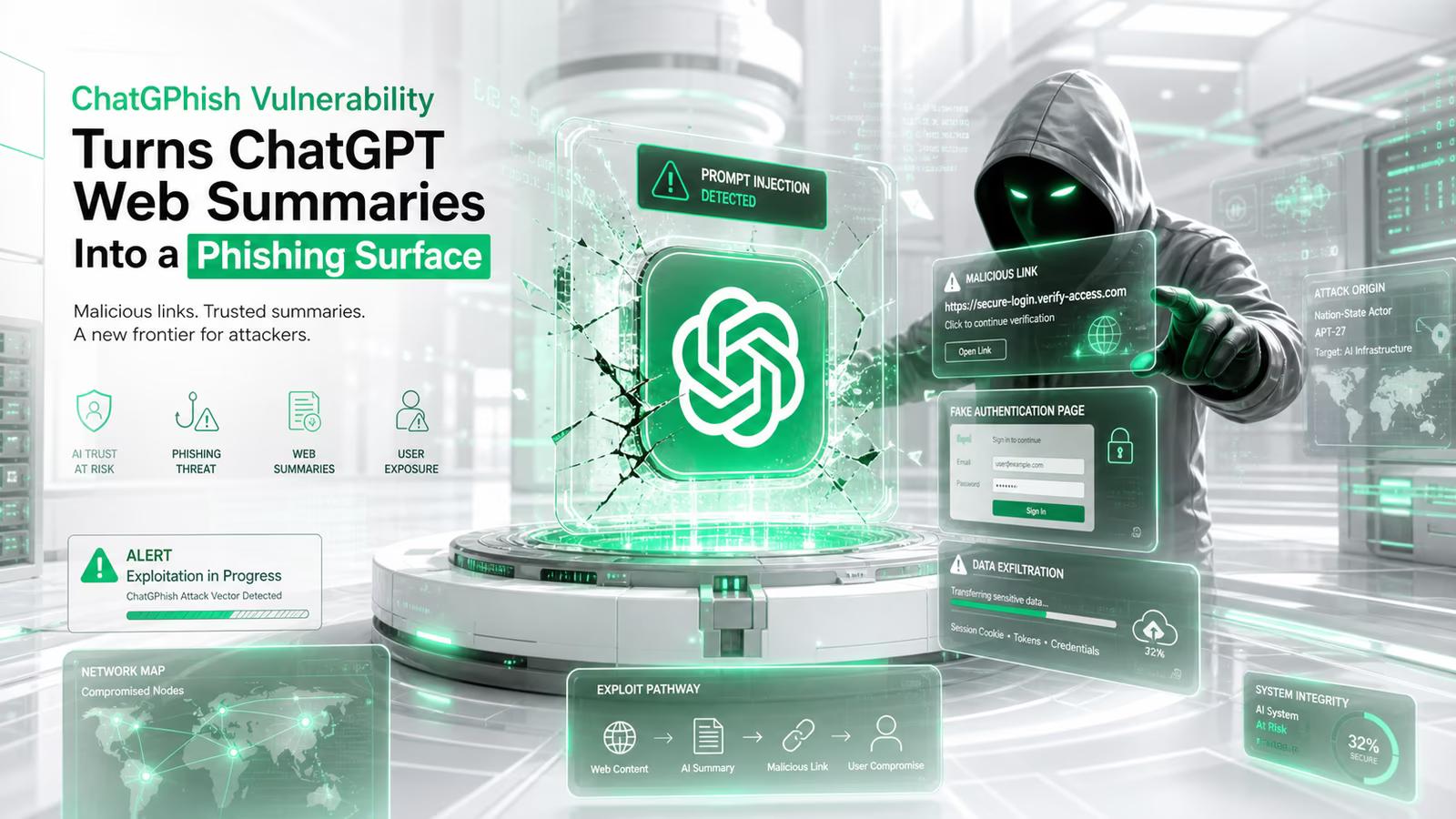
ChatGPT's web summary renderer trusts external Markdown, enabling indirect prompt injection attacks that deliver phishing links inside trusted AI responses.

  1. Home
  2. ›
  3. IA
  4. ›
  5. ChatGPhish: how ChatGPT web summaries become phishing lures
by Gorka El Bochi Morillo
·
2 min read
·June 3, 2026

What happened

Permiso Security documented ChatGPhish, a technique that turns ChatGPT's web browsing summary feature into a phishing vector. The root cause sits in the chatgpt.com response renderer: when the model visits a URL to summarize it, it trusts whatever Markdown it finds on that page. If the page embeds crafted Markdown links, the renderer surfaces them as clickable links in the response — with no visual indicator that they originated from external, untrusted content.

The attack mechanism is *indirect prompt injection* (malicious instructions embedded in external content the model processes — the attacker hijacks model behavior without direct access): the attacker never interacts with the model directly. The victim simply asks ChatGPT to summarize an attacker-controlled page. The model follows the embedded Markdown and delivers a phishing link as part of its apparently legitimate response.

Why it matters

Classic phishing requires the victim to receive a suspicious email or navigate to a malicious URL on their own. ChatGPhish removes that friction: the user acts from within the ChatGPT interface — an environment they perceive as safe. The malicious link doesn't arrive in a spam email; it arrives inside a trusted AI assistant's reply.

That shift in delivery context is the key threat amplifier. Users trained to distrust links in emails have no equivalent reflex for links inside ChatGPT responses. The attack surface covers every user with access to the web browsing feature — millions of accounts on Plus, Pro, and Team plans.

The pattern also generalizes beyond OpenAI. Any LLM that renders Markdown from external content without sanitizing it carries the same exposure: Microsoft Copilot, Google Gemini, any agent with a browse tool. ChatGPhish is not a one-off OpenAI bug — it's a systemic design gap in how LLMs handle trust from external content.

What to do

  • Disable ChatGPT web browsing in Settings → Data controls → Browse the web, if you don't actively use it.
  • Audit any internal workflow that uses ChatGPT to summarize URLs — especially if results are shown to end users without human review.
  • Train your team to hover and verify link destinations before clicking anything inside a ChatGPT response.
  • If you build on the OpenAI API with browse tools, sanitize the Markdown the model returns before rendering it in your interface.
  • Watch internal channels for links team members say came "from ChatGPT" — social engineering attacks can use ChatGPhish as a legitimacy layer.

The root issue is not ChatGPT-specific: no LLM Markdown renderer should implicitly inherit user trust over external content. Until OpenAI and other vendors fix this at the renderer layer — with explicit external-origin warnings or by disabling link rendering from visited pages — the attack surface remains open in production.

What to do

  • Disable ChatGPT web browsing in Settings if you don't use it daily
  • Sanitize Markdown returned by LLMs before rendering it in your app
  • Hover to verify link destinations before clicking inside any ChatGPT response

Share this story

Help more people discover BBLabs News.

ChatGPhish: how ChatGPT web summaries become phishing lures
VerticalDownload image
LinkedInXWhatsApp

Interested in IA?

Subscribe to this stream and get the most relevant news every day — no spam, no noise.

Subscribe

Related articles

Destacado
IA2 jun 2026·2 min

Claude Mythos goes public: what the security delay means

Anthropic confirms Mythos-class Claude models will reach the public after a delay over software security risks.

  • Audit every AI agent's permissions — cut access to code, infra, and credentials to minimum.
  • Review LLM API pipelines for prompt injection surface before Mythos-class models ship.
  • Enable production output logging now so you can detect anomalous model behavior on day one.
Gorka El Bochi Morillo
Leer artículo
IA1 jun 2026·1 min

GreyVibe uses ChatGPT & Gemini to power cyberattacks

Russian-linked GreyVibe cluster weaponizes ChatGPT and Gemini to generate phishing lures targeting Ukrainian organizations.

Leer artículo
IA31 may 2026·2 min

ChatGPT share links abused to deliver malware

Threat actors are abusing ChatGPT share links to serve fake OpenAI outage pages that deliver malware disguised as the desktop app.

Leer artículo

Want to get news like this every day?

Browse all articles
BBLabs NewsBBLabs News

BBLabs News

Una historia al día. Cero ruido.

Newsletter técnica de ciberseguridad. Una historia al día sobre CVEs críticos, brechas, bug bounty e IA. Filtrado por IA, escrito para humanos.

Producto

  • Hemeroteca
  • Ediciones
  • Temas
  • Glosario
  • RSS
  • Atom
  • JSON Feed

Editorial

  • Acerca de
  • Suscribirse
  • Cuenta
  • English

Legal

  • Privacidad
  • Términos
  • Contacto: team@bblabs.es

Conectar

  • YouTube · @0xGorka
  • Instagram · @bblabs.es
  • Discord BBLabs
  • Discord Bug Bounty ES
29 artículos·9 ediciones·Desde 2026·Hecho en España
© 2026 BBLabs News·Por Gorka El Bochi