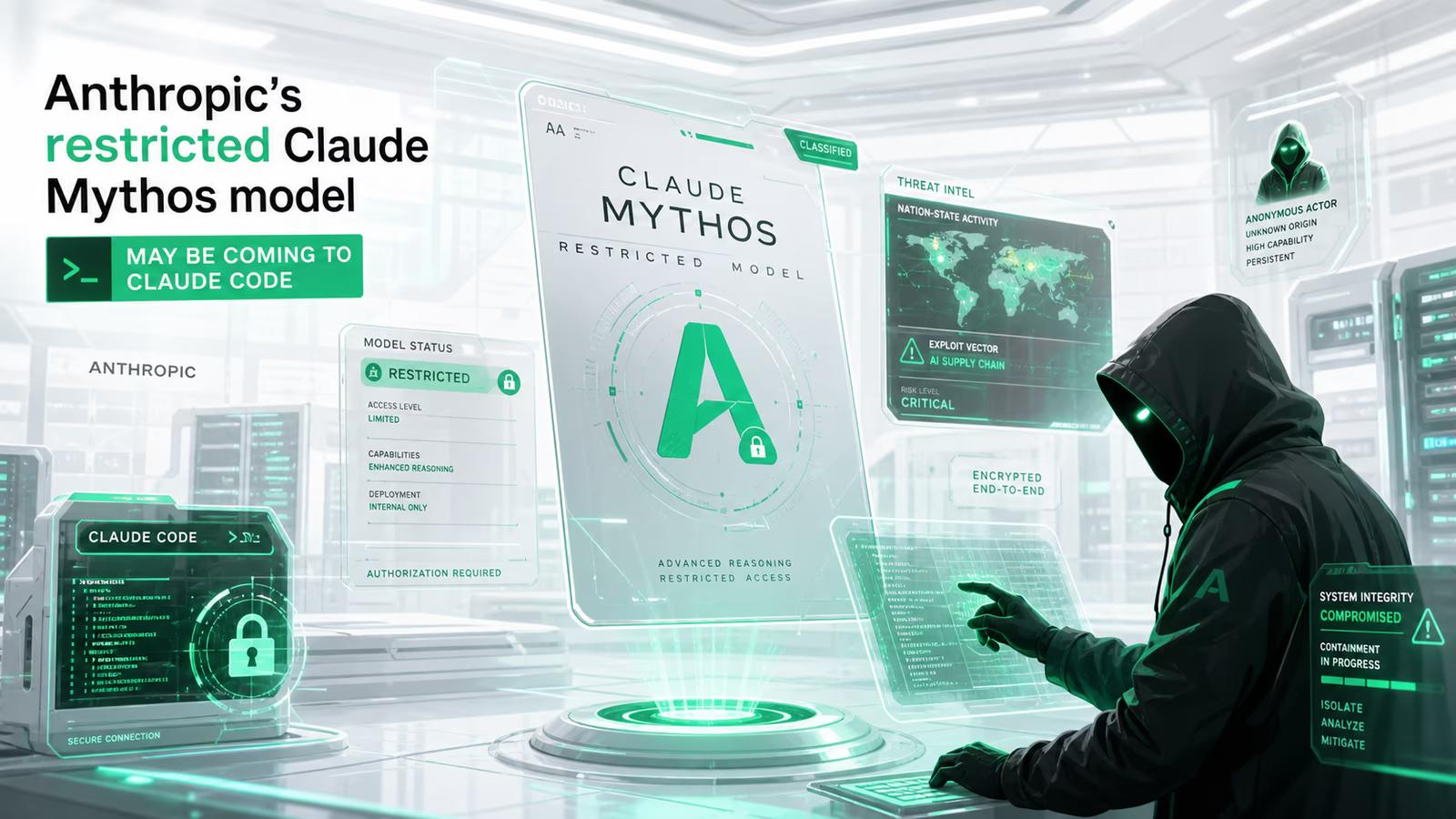
Anthropic is preparing to roll out Mythos to Claude Code, a restricted model flagged for major security risks to public and private software.
Anthropic appears to be preparing a public rollout of Claude Mythos inside Claude Code, according to BleepingComputer. Mythos was announced in April 2026 as an advanced-capability model under restricted access — flagged by Anthropic itself for major security risks to private and public software.
What makes Mythos unusual is that it reportedly crosses specific internal thresholds in Anthropic's evaluations — thresholds that typically indicate capabilities relevant to *autonomous exploitation* (active assistance in finding and leveraging vulnerabilities) beyond what standard models provide. This isn't just a smarter model in the general sense; it's one with an offensive-security-relevant capability profile.
Claude Code is an agentic AI environment (AI that operates autonomously on real systems — executes code, reads files, calls APIs, modifies repos) running locally with broad permissions over a developer's environment. Pairing it with that risk profile is not a trivial decision.
The concern isn't the model in isolation. It's the combined attack surface:
If Mythos reasons better about vulnerabilities, it's also more weaponizable via prompt injection: an attacker controlling any text the agent reads could instruct it to exfiltrate code, credentials, or run unauthorized commands.
Anthropic has shown with its Responsible Scaling Policy (RSP) that it takes these thresholds seriously. But deploying Mythos in an agentic context — where the model acts, not just responds — is a bet worth watching closely.
The pattern is well-established: the most capable models land first in developer tooling, which is the highest-value target. Whoever controls the agent touching your code controls a lot more than a chatbot.
Help more people discover BBLabs News.
Want to get news like this every day?
Browse all articles